

- In Short: The Best AI Voice Agents
- The best AI voice agents at a glance
- How did we choose these AI voice agents?
- Do you want a ready-made AI voice agent or one you build yourself?
- The 12 best AI voice agents in 2026
- How much do AI voice agents cost?
- Which AI voice agent is best for your use case?
- How do you evaluate an AI voice agent before buying?
- Run AI voice agents and your team on one phone system
- AI Voice Agent FAQs

Ready to build better conversations?
Simple to set up. Easy to use. Powerful integrations.
Get free access- In Short: The Best AI Voice Agents
- The best AI voice agents at a glance
- How did we choose these AI voice agents?
- Do you want a ready-made AI voice agent or one you build yourself?
- The 12 best AI voice agents in 2026
- How much do AI voice agents cost?
- Which AI voice agent is best for your use case?
- How do you evaluate an AI voice agent before buying?
- Run AI voice agents and your team on one phone system
- AI Voice Agent FAQs
Ready to build better conversations?
Simple to set up. Easy to use. Powerful integrations.
Get free accessSupport queues don’t break gradually. They break the week a product launch lands or a billing cycle shifts, and the team that handled 400 calls a day is suddenly facing 1,200. Hiring takes months. The queue doesn’t wait.
AI voice agents, also called AI call agents or AI phone agents, take those calls on their own. They hold a natural conversation, pull context from your CRM or helpdesk, complete the task (book the appointment, qualify the lead, check the order) and hand the call to a person, with context, when it needs one.
This guide is based on our own editorial analysis of the AI voice agent market. We assessed each platform’s pricing, documentation and product capabilities, then picked the 12 worth shortlisting, with what each one costs, where it falls short and who should skip it. Aircall makes one of them, so every competitor’s pricing below comes from that vendor’s own site.
In Short: The Best AI Voice Agents
Best overall for business teams: Aircall. AI voice agents run inside your phone system, and telephony, the language model and voices are included in one price, from $250 a month for 1,000 minutes.
Best for developers: Retell AI ($0.07 to $0.31 per minute) and Vapi ($0.05 per minute plus model costs).
Best for high-volume outbound calling: Bland AI ($0.14 per minute on its free Start plan).
Best voice quality: ElevenLabs Agents ($0.08 per minute, with the language model billed separately).
Best for large contact centers: PolyAI, Sierra, Decagon and NiCE Cognigy. All are sold through sales, except PolyAI’s new self-serve plans from $49 a month.
Rule of thumb: compare the all-in cost per minute (platform, model, voice and telephony), not the headline rate.
The best AI voice agents at a glance
| Voice agent platform | Top voice capability | Who is it best for? | Starting price $USD | Telephony included? |
|---|---|---|---|---|
Aircall | Answers and places calls, SMS & WhatsApp | AI agents and people on one phone system | 100 free minutes, then $0.29 per minute | Yes |
Retell AI | Fast turn-taking and interruption handling | Production teams building custom agents | $0.07 to $0.31 per minute | Extra, or free on your own |
Vapi | Swap, speech and voice providers per agent | Developers who want full stack control | $0.05 per minute plus model costs | Vapi SIP free, carriers extra |
Bland AI | Batch outbound calling | High-volume outbound calling | $0.14 per minute | Extra |
Synthflow | No-code call flows for booking and routing | Managed enterprise rollouts | Annual contract, no public rate | Yes |
ElevenLabs Agents | Expressive voices in 90+ languages | Natural-sounding voices | $0.08 per minute, model extra | Yes |
PolyAI | Multi-turn inbound calls with topic switches | Complex inbound calls | $49 a month for 250 minutes | Yes |
Sierra | On-brand agents priced per outcome | Consumer brands paying for outcomes | Outcome-based, custom | Custom |
Voiceflow | Visual design of complex call logic | Teams designing agents together | Free trial, then usage-based | No |
NiCE Cognigy | Adds AI agents to existing contact center lines | Contact centers on an existing enterprise platform | Per conversation, custom | No |
Decagon | One agent across voice, chat and email | Support across chat, email and voice | Per conversation or resolution | Custom |
Dialpad | AI agents that share context with your team's calls | Teams already on Dialpad | Custom | Yes |
Prices are list prices from each vendor’s site in November 2026, before taxes and add-ons.
How did we choose these AI voice agents?
This list comes from our own editorial analysis. We screened more than 20 AI voice agent platforms, then assessed the shortlist using each vendor’s pricing pages, product documentation and published capabilities. The final 12 cover three types of buyer: teams that want AI agents in their phone system, teams building their own agents and large contact centers.
We then compared each platform on the factors that decide whether a voice agent works in production:
Conversation quality: interruption handling, turn-taking speed and how natural the voice sounds
Actions: whether the agent can read and write to your CRM, helpdesk or calendar during the call
Handoffs: whether a person receives the call with context, or the caller starts over
All-in cost: platform, model, voice and telephony per minute, not the headline rate
Setup effort: self-serve in a day, or a sales-led rollout
Security and compliance: options like HIPAA agreements, SOC 2 and data residency
Every price comes from the vendor’s public pricing page or documentation. Prices in this category change often, so confirm before you buy.
Do you want a ready-made AI voice agent or one you build yourself?
Many buying mistakes start before the first demo, when teams compare agents that are set up in very different ways. The 12 platforms here work in one of three ways:
Ready-made agents on your business phone line (Aircall, Dialpad): the AI agent, your numbers, routing and your team’s calls live in one system. This is the fastest route for sales and support teams without engineers to spare.
Agents you build yourself (Retell AI, Vapi, Bland AI, Synthflow, ElevenLabs Agents, Voiceflow): you design the call flow and choose the speech, language model, voice and phone provider, using code or a visual builder. You get the most control and do the most setup.
Agents deployed with the vendor for large contact centers (PolyAI, Sierra, Decagon, NiCE Cognigy): the vendor helps design, test and launch agents for high call volumes, usually priced per conversation or per outcome.
One more distinction matters: automation versus augmentation. AI voice agents take calls off the queue. AI coaching tools, such as AI Assist Pro, help your reps handle the calls that stay with people. Buying one when you need the other is a common selection error. For the fundamentals, read what an AI voice agent is and how it works.
The 12 best AI voice agents in 2026
1. Aircall: best for teams that want AI agents inside their phone system
Most voice AI failures are data failures. The agent handles the conversation well, then drops the outcome into a system nobody reads, and the customer repeats themselves on the callback. Aircall’s AI Voice Agents run on the same phone system as your team, so AI-handled and team-handled calls write to the same records, and every handoff arrives with the context attached.
Best for: sales and support teams of any size that want AI voice agents without managing models, voice providers or SIP trunks.

What stands out:
One price covers telephony, the language model, voices and unlimited call concurrency, with no token charges.
Native integrations with HubSpot, Salesforce, Zendesk, Shopify, Stripe and Calendly let the agent check an order, create a ticket or book a meeting before the call ends.
One agent covers inbound calls, outbound calls, SMS and WhatsApp, in 38 languages, with numbers in 100+ countries.
Warm transfer hands the caller to a rep with the conversation context, and analytics cover AI and human calls in one view.
Ready-made agents cover common jobs: the AI Receptionist, AI Sales Agent, AI Support Agent and AI Order Agent.
Proof: SJWD Water District handles 90% of after-hours calls automatically and cut resolution times by 63%. TripCity resolves 87% of calls without escalating to a person, and Food Cycle Science responds 4.5x faster with AI routing.
Pricing: bundles from $250 a month for 1,000 minutes and $805 for 3,500 minutes (annual term), or pay as you go at $0.29 per minute after 50 free minutes a month. New customers get 100 free minutes to try it.
Pros:
No separate bills for the model, voice or telephony
Works with or without the Aircall phone system
US and Canadian accounts can try four pre-built agents from the browser with no setup
Forward Deployed Engineer support is included on bundles of 1,000 minutes and above
Cons:
Less low-level control over the model stack than developer platforms like Vapi or Retell AI
Bundles bill on an annual term
Choose it if: you want AI agents and your team on one phone system, with a predictable monthly cost.
Skip it if: you’re building a voice product of your own and need to swap models and voice providers call by call.
2. Retell AI: best for production teams building custom agents
Retell AI is a popular choice for teams building their own voice agents, and its pricing page itemizes every component. The platform is tuned for fast turn-taking and interruption handling. That matters most on outbound calls: a caller who wants help will tolerate a slightly stiff voice, but a prospect who didn’t ask to be called hangs up within seconds.
Best for: product and engineering teams that want fast deployment with control over the model and voice.
What stands out:
Itemized pricing: $0.055 per minute for voice infrastructure, plus your chosen model and voice
20 concurrent calls included, then $8 per extra line per month
Built-in call transfer, appointment booking, knowledge bases, batch calling and post-call analysis
SOC 2 certification, with HIPAA agreements available
Pricing: $0.07 to $0.31 per minute, pay as you go, with $10 in free credits. Premium voices change the math: ElevenLabs voices on Retell AI cost $0.04 to $0.10 per minute for the voice alone.
Pros:
Transparent, per-component pricing
Self-serve, with no contract needed to start
Cons:
Your team owns prompt design, testing and tuning
Phone numbers ($2 a month each) and telephony add to the per-minute rate
Choose it if: someone technical will own the agent’s prompts and testing.
Skip it if: you want a managed setup and one bill that covers telephony.
We compare the two platforms in detail in Aircall vs Retell AI.
3. Vapi: best for developers who want full control of the stack
Vapi gives developers the parts and lets them wire them together: transcription, language model, voice and telephony are each chosen separately. That flexibility makes it a common choice for engineering teams building voice into their own products. It also means the advertised $0.05 per minute covers hosting only.
Best for: engineering teams building custom voice products or complex multi-agent call flows.
What stands out:
Model-agnostic, so you can swap transcription, model and voice providers without rebuilding
Vapi’s own calculator puts 1,000 minutes at roughly $83 to $129 all-in, depending on the model and voice
Free Vapi SIP and WebSocket transport, or bring Twilio, Vonage or Telnyx
Pricing: $0.05 per minute for hosting plus models at cost, with $5 in free credits. Support packages start at $29 a month, the Pro package has a $999 monthly minimum, and HIPAA-eligible data handling is a $2,000 a month add-on.
Pros:
No lock-in to one model or voice provider
Deep control through the API
Cons:
Production reliability depends on your engineers
Compliance and support packages add fixed monthly costs
Choose it if: voice is part of your product and you have engineers to run it.
Skip it if: you need a working agent this week without writing code.
4. Bland AI: best for high-volume outbound calling
Bland AI is built for scale, with batch calling, high daily call limits and its own speech and reasoning models. Unlike Vapi and Retell AI, its per-minute rate includes the language model, transcription and voice, so the number you see is closer to what you pay. Telephony is the exception: it’s billed separately, on your own carrier or Bland’s at cost.
Best for: teams running large outbound campaigns, such as lead follow-up, reminders and notifications.
What stands out:
One rate covers the model, speech-to-text and text-to-speech, with no token charges
A visual builder for scripted, multi-step call flows
The Build plan raises limits to 50 concurrent calls and 2,000 calls a day
Pricing: the Start plan is free to join at $0.14 per minute. Build costs $299 a month plus $0.12 per minute. Transferred minutes cost $0.04 to $0.05 extra. Bland raised its standard rate from $0.09 to $0.14 per minute in December 2025, so older comparisons understate the cost.
Pros:
Predictable model costs inside the per-minute rate
Built for outbound volume
Cons:
A steeper learning curve for complex call logic
The Start plan is capped at 100 calls a day and 10 concurrent calls
Choose it if: outbound volume is the job.
Skip it if: most of your calls are inbound support that needs deep helpdesk context.
5. Synthflow: best for a managed, no-code enterprise rollout
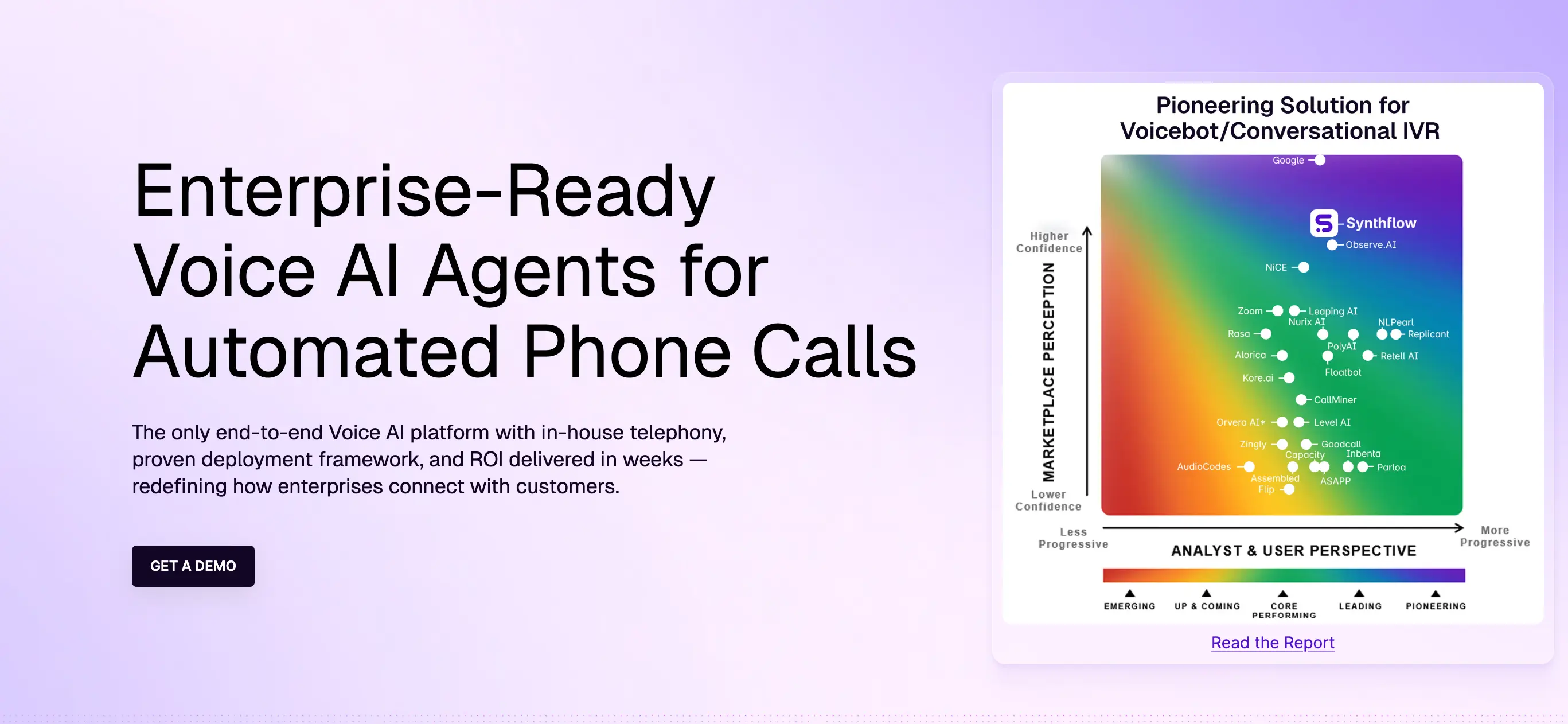
Synthflow built its name on a no-code builder that non-technical teams could use, and some rankings still describe it as a self-serve option. That is out of date. Synthflow now sells only annual enterprise agreements, with no free plan, no trial and no per-minute rate. Each contract covers telephony, integrations, security review and launch support.
Best for: mid-market and enterprise teams that want a vendor-led deployment with a visual builder.
What stands out:
A no-code builder for appointment booking, qualification and routing flows
Contract scope includes telephony, concurrency planning and launch support
Pricing: an annual enterprise agreement scoped to call volume, phone system, integrations and security needs. There’s no public rate.
Pros:
Non-technical teams can edit call flows
One contract covers the full deployment
Cons:
No way to test it before a sales process
Flow-based agents need careful design for callers who go off script
Choose it if: you want a managed rollout and a no-code builder.
Skip it if: you want to start small, self-serve or pay per minute.
See how the two compare in Aircall vs Synthflow.
6. ElevenLabs Agents: best for natural-sounding voices
ElevenLabs started as a voice synthesis company, and voice quality is still the reason to pick it: expressive voices with fine control over tone and pacing. Its agent platform now handles inbound and outbound calls, knowledge bases and telephony.
Best for: brands where voice quality is the deciding factor.
What stands out:
A large voice library, voice cloning, and newer voice models covering 90+ languages
Telephony included at no extra charge, unless you connect your own provider
Pricing: $0.08 per minute, with plans from $6 a month (15 minutes included) up to $990 a month (12,375 minutes). The language model is billed separately, and calls above your plan’s concurrency limit cost $0.16 per minute.
Pros:
Some of the most natural voices available
Low entry price for testing
Cons:
Language model costs sit on top of the per-minute rate
Fewer contact center features, such as queues and team routing, than AI agents that run on a business phone system
Choose it if: callers must never hear a synthetic-sounding voice.
Skip it if: you need predictable all-in pricing at high call volume.
7. PolyAI: best for complex inbound calls at enterprise scale
PolyAI built its reputation on enterprise inbound calls in hospitality, retail and financial services, where callers switch topics, speak with heavy accents and rarely follow a script. What most rankings miss is the pricing change: PolyAI now offers self-serve plans, so it’s no longer an enterprise-only purchase.
Best for: inbound-heavy businesses with complex, multi-turn calls.
What stands out:
Self-serve plans with an included number and Google Calendar integration
A developer platform billed by the minute, plus model-only API access
Enterprise contracts for large contact centers
Pricing: Essentials is $49 a month (250 minutes, then $0.30 per minute), Plus is $199 (1,000 minutes, then $0.25) and Scale is $299 per location (1,500 minutes per location). The developer platform starts at $0.095 per minute, and enterprise pricing is custom.
Pros:
Strong on messy, multi-step inbound conversations
Now testable without a sales cycle
Cons:
Enterprise deployments are still scoped and priced through sales
Self-serve plans cap concurrent calls at 5 to 10
Choose it if: your callers have complex, multi-step requests.
Skip it if: you want AI agents and your team’s calls on one phone system with shared reporting.
8. Sierra: best for consumer brands that want to pay for outcomes
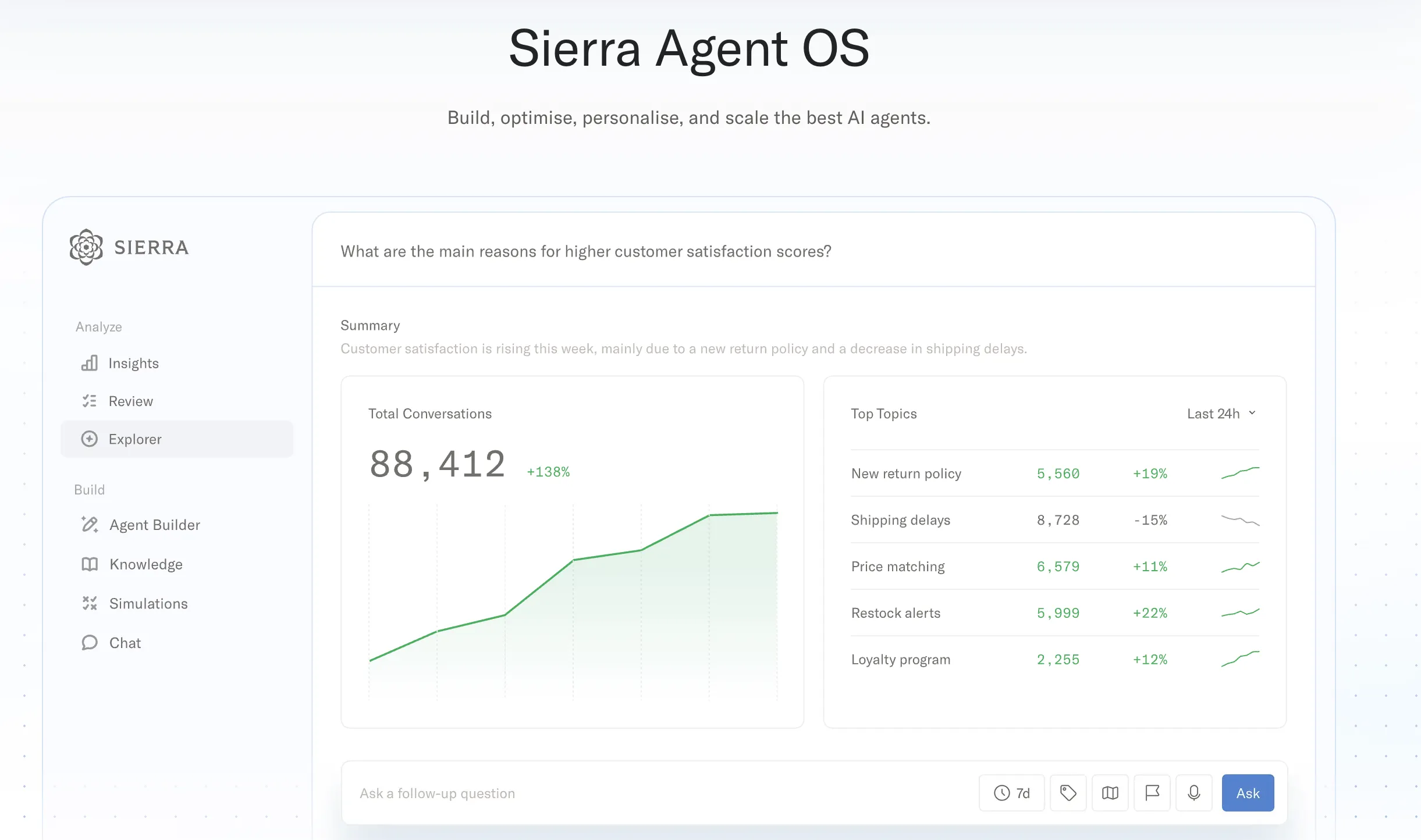
Sierra’s agents handle voice and chat for large consumer brands, and its pricing is why it appears on so many shortlists. You pay when the agent achieves an agreed outcome, such as a resolved conversation or a saved cancellation, and Sierra says escalations to a person usually aren’t charged.
Your vendor’s incentive is tied to your resolution rate instead of your call volume. The tradeoff is budgeting: the invoice moves with demand, so finance needs a forecast and a written definition of “resolved” before anyone signs.
Best for: enterprise consumer brands with documented resolution paths.
What stands out:
Outcome-based pricing with agreed criteria for each outcome
Controls for keeping the agent on brand in tone and vocabulary
One agent across voice and chat
Pricing: outcome-based, custom contracts.
Pros:
Vendor incentives tied to results
Escalations usually not billed
Cons:
No public pricing
Outcome definitions need careful negotiation
Choose it if: you can define and measure a resolution across your systems.
Skip it if: you need fixed, predictable monthly costs.
Pro tip: before signing any outcome-based contract, run the vendor’s definition of a resolution against 100 of your own closed tickets. If you’d classify a meaningful share differently, renegotiate the definition, not the rate.
9. Voiceflow: best for teams designing agents together
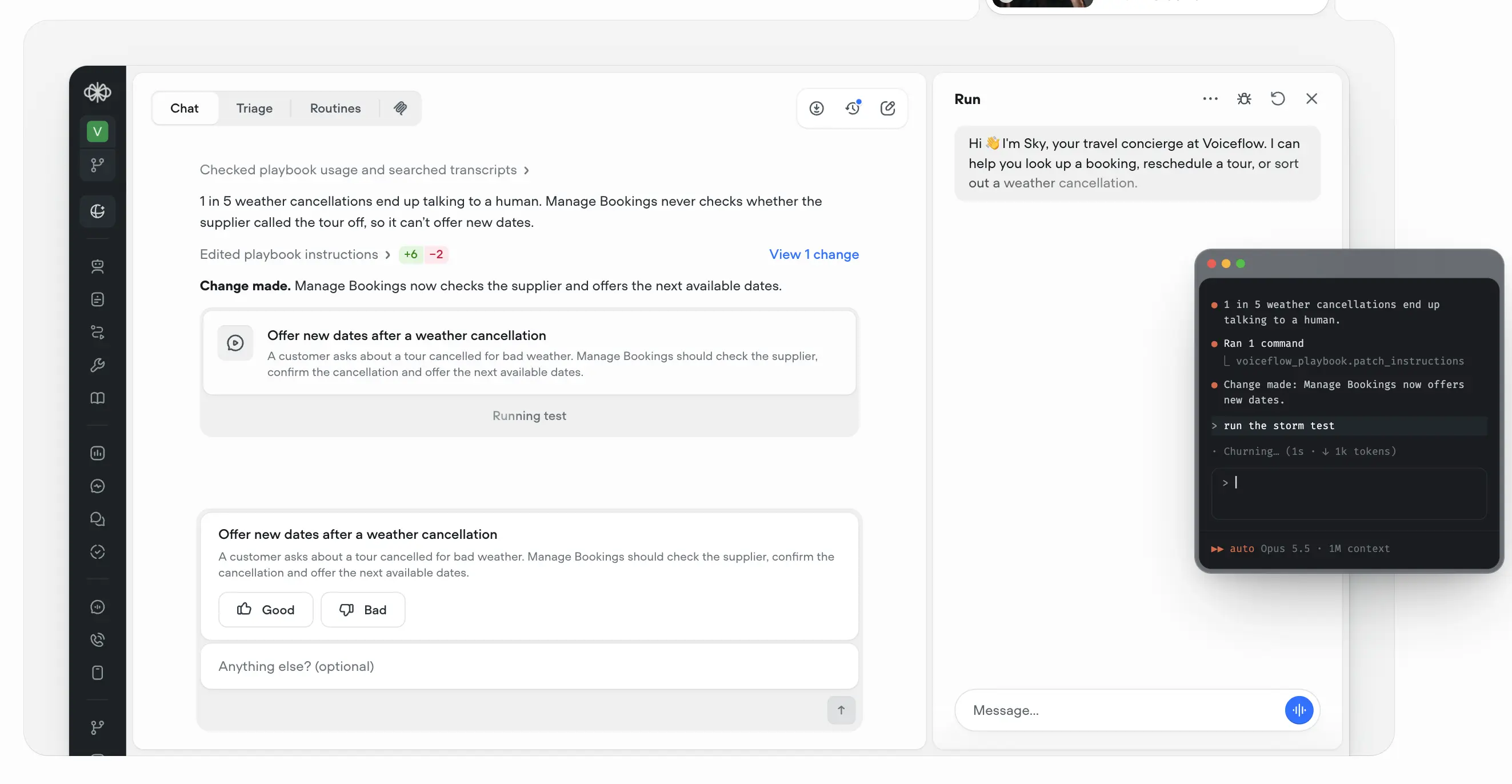
Packaged agents work when your workflows look like everyone else’s. Voiceflow is for when they don’t: an eligibility check with three branches, a flow that depends on live inventory, or a compliance script that must be read word for word. CX designers map the logic on a shared canvas, engineers connect the APIs in the same project, and QA can test a path without filing a ticket.
Best for: CX and product teams with a dedicated conversation designer.
What stands out:
A collaborative visual builder for designers and engineers
Support for multiple language model providers
Built-in conversation simulation and performance analytics
Pricing: a free trial with no card required, then usage-based billing. Business pricing goes through sales.
Pros:
Flexibility for unusual business logic
Design and engineering work from one project
Cons:
Your team decides every fallback, interruption rule and escalation threshold
Phone deployment needs a separate telephony provider
Choose it if: you have a conversation designer and unusual call logic.
Skip it if: you want a working agent without designing every path.
10. NiCE Cognigy: best for contact centers already on an enterprise platform
Cognigy, now part of NiCE, adds AI agents to the contact center infrastructure large enterprises already run instead of replacing it. Its Voice Gateway connects to major contact center platforms, and Agent Copilot gives reps context during live calls.
Best for: large contact centers running NiCE, Genesys or Avaya.
What stands out:
Connects to existing enterprise telephony rather than replacing it
Handover from AI to a person with the full conversation history
Broad multilingual support
Pricing: billed per conversation, with extra charges for items like Voice Gateway lines. Contracts go through sales.
Pros:
Fits existing enterprise contact center stacks
Strong AI-to-person handover
Cons:
Setup needs IT, operations and CX teams working together
Not built for small teams or self-serve
Choose it if: you’re extending an enterprise contact center you already run.
Skip it if: you’re starting from scratch or need to go live in days.
11. Decagon: best for automating support across chat, email and voice
Decagon’s AI agents resolve support requests across chat, email and voice from one set of instructions, with memory that carries across channels. Voice is Decagon’s newer channel, so teams leading with phone calls should test it against voice-first platforms.
Best for: enterprise support teams consolidating channels under one AI agent.
What stands out:
One set of agent instructions across chat, email and voice
Simulation testing and QA tooling
A choice of two pricing meters
Pricing: per conversation or per resolution, with no public rates.
Pros:
Cross-channel memory
An outcome-based option for teams that want it
Cons:
Sales-led, annual contracts only
Voice is less mature than its chat product
Choose it if: you want one AI agent across every support channel.
Skip it if: phone is your main channel and you need voice-first tooling.
12. Dialpad: best for teams already on Dialpad
Dialpad is the other business phone system on this list with its own AI agents for voice and digital channels. Like Aircall, its agents share customer context with your team’s calls, which makes it a natural option for existing Dialpad customers.
Best for: teams already running Dialpad for calls.
What stands out:
AI agents for voice and digital channels, with handoffs to people
AI built on Dialpad’s own business conversation data
Pricing: custom pricing for AI agents. Phone plans are priced per user.
Pros:
One vendor for phones and AI agents
Shared context between AI and human calls
Cons:
No public AI agent pricing
Less useful if you’re not already on Dialpad
Choose it if: you’re already a Dialpad customer.
Skip it if: you want to see what AI minutes cost before talking to sales.
How much do AI voice agents cost?
AI voice agents are priced in four ways, and headline rates aren’t comparable because some include the model, voice and telephony while others charge for each separately:
Per minute (Retell AI, Vapi, Bland AI, ElevenLabs): you pay for connected time, so check which components the rate covers.
Bundled minutes (Aircall, PolyAI): a monthly allowance at a lower effective rate per minute.
Per conversation (NiCE Cognigy, Decagon): a fixed fee per interaction, whatever its length.
Per outcome (Sierra, Decagon): you pay only when the agent resolves the request.
What do 1,000 minutes a month cost?
Platform | Approximate cost for 1,000 minutes | What’s not included
|
|---|---|---|
Aircall | $250 on a bundle, or about $276 pay as you go | Nothing: telephony, model and voices are included |
PolyAI | $199 on the Plus plan | Overage above 1,000 minutes at $0.25 per minute |
Retell AI | $70 to $310, depending on model and voice | Phone numbers, and telephony if you use Retell’s |
Vapi | $83 to $129, by Vapi’s own estimate | Carrier fees outside Vapi SIP, and support packages |
Bland AI | $140 on the Start plan | Telephony and transferred minutes |
ElevenLabs Agents | $99 on the Pro plan (1,238 minutes included) | Language model usage |
Synthflow, Sierra, NiCE Cognigy, Decagon, Dialpad | Quote only | Varies by contract |
The cheapest headline rate is rarely the cheapest bill. Price three months of your real call volume, including concurrency, phone numbers, compliance add-ons and support. For a deeper breakdown, read our guide to AI voice agent costs.
Which AI voice agent is best for your use case?
Use case | Best picks | Why
|
|---|---|---|
Sales and lead qualification | Aircall, Retell AI, Bland AI | CRM write-back, outbound triggers and meeting booking on the call |
Customer support and call deflection | Aircall, PolyAI, Decagon | Helpdesk integrations, resolution tracking and handoff with context |
High-volume contact centers | PolyAI, NiCE Cognigy, Sierra | Enterprise scale, multilingual support and outcome or conversation pricing |
Small businesses | Aircall, PolyAI | Predictable bundles and no engineering needed |
Developers building voice products | Vapi, Retell AI, ElevenLabs Agents | Model choice, API control and voice quality |
Which AI voice agent is best for sales and lead qualification?
The best AI voice agent for lead qualification is one that writes structured answers into your CRM and books the meeting before the call ends. For inbound leads, that means Aircall, Retell AI or another agent with native CRM write-back. For high-volume outbound prospecting, Bland AI and Retell AI are the most common picks.
A lead-qualifying agent should:
Call or answer within minutes of a form fill, since speed to lead decides whether you reach the prospect at all
Ask your qualification questions, such as budget, timeline, decision maker and current tools, and score the answers against your threshold
Save each answer as a structured CRM field, not only a transcript
Book the meeting on the call, or transfer a high-intent lead to a rep live
Respect consent, opt-out and calling-hour rules for outbound calls
Aircall’s AI Sales Agent triggers outbound calls when a lead arrives, qualifies the lead, updates HubSpot or Salesforce and books the meeting through Calendly. For tools that automate more of the SDR role, see our list of AI SDR tools.
Which AI voice agent is best for customer support?
For most support teams, the best AI voice agent is one that resolves routine calls end to end and passes the rest to a person with full context. Aircall and PolyAI fit inbound-heavy teams, while Sierra, Decagon and NiCE Cognigy suit large enterprises with documented resolution paths. Track resolution rate and transfer rate, not only call volume handled. Aircall’s AI Support Agent connects natively to Zendesk and other helpdesks, and if after-hours coverage is the main need, compare options in our guide to the best AI receptionist software.
How do you evaluate an AI voice agent before buying?
Demos reward charisma. Production rewards integration, speed and cost control. Run every shortlisted platform through the same checks:
Test on a real phone line, not a browser demo. Interrupt the agent mid-sentence and change topic. Natural interruption handling separates agents callers tolerate from agents they hang up on.
Run your real call types. Use your 20 most common calls, including the awkward ones, and judge inbound and outbound separately.
Check what writes back. After each test call, look for structured fields in your CRM or helpdesk, not just a transcript or summary.
Test a handoff end to end. See what context reaches the person who picks up, and whether the caller has to repeat anything.
Price your real volume. Model three months of minutes, including telephony, the language model, concurrency and add-ons.
Confirm security and compliance. Ask about HIPAA agreements, SOC 2 reports and where call data is stored. Aircall, for example, offers regional storage for AI data.
Response speed is the spec to watch. Each turn passes through speech-to-text, a language model and text-to-speech, and larger models or premium voices add delay. A pause of more than about a second makes callers start talking over the agent.
Run AI voice agents and your team on one phone system
The teams getting the most from AI voice agents run AI and people on one communications layer, where every call writes to the same records and every handoff carries its context. The AI handles what it handles well, and your team picks up the rest already knowing what happened.
Aircall’s AI Voice Agents give you that from day one, with telephony, the model and voices in one price and 250+ native integrations. See Aircall’s AI Voice Agents or get started with 100 free minutes.
AI Voice Agent FAQs
What is the best AI voice agent in 2026?
Aircall is the best AI voice agent for most business teams in 2026, because its agents run inside the phone system your team already uses, with telephony, the model and voices included from $250 for 1,000 minutes. Retell AI and Vapi are the best choices for developers, Bland AI for high-volume outbound calling and PolyAI for complex inbound calls at enterprise scale.
What is an AI voice agent?
An AI voice agent is software that answers and places phone calls on its own. It converts the caller’s speech to text, uses a language model to understand the request and replies in a natural voice in real time. It can answer questions, qualify leads, book appointments and update business systems, then transfer the call to a person when needed. Read more in what is an AI voice agent.
Are AI call agents and AI phone agents the same as AI voice agents?
Yes. AI call agent, AI calling agent, AI phone agent and AI voice agent all describe software that holds phone conversations on its own. Some vendors use AI voice agent more broadly to include voice assistants on websites and apps.
How much does an AI voice agent cost?
AI voice agents cost roughly $0.07 to $0.31 per minute on usage-based platforms where you build the agent yourself, before telephony on some of them. Bundled plans like Aircall’s start at $250 a month for 1,000 minutes with everything included, and Sierra, Decagon and NiCE Cognigy price per conversation or per outcome through custom contracts.
Can an AI voice agent qualify sales leads?
Yes. An AI voice agent can ask qualification questions, score the answers, save them to your CRM and book a meeting during the same call. The best results come from calling new leads within minutes and transferring high-intent prospects to a rep live.
Which AI voice agents transfer calls to a person most reliably?
AI voice agents that run on the same phone system as your team transfer most reliably, because the person who picks up already sees the conversation. Aircall and Dialpad work this way. Platforms where you build the agent yourself, such as Retell AI and Vapi, support transfers too, but how much context survives depends on how your team configures them, so test a transfer before you buy.
Why do AI voice agents sometimes respond slowly?
AI voice agents respond slowly when one of the three steps in each turn (speech-to-text, the language model or text-to-speech) takes too long. Larger models, premium voices and extra telephony routing all add delay. Test on a real phone line and interrupt the agent to see how it copes.
Can you use an AI voice agent for free?
Most platforms offer a free trial rather than a free plan. Aircall gives new customers 100 free minutes, Retell AI includes $10 in credits, Vapi includes $5, ElevenLabs has a free tier with 15 minutes and Bland AI’s Start plan is free to join, with calls billed per minute.
Do you need to replace your phone system to use an AI voice agent?
No. Aircall’s AI Voice Agents work with or without the Aircall phone system, and platforms like Retell AI and Vapi connect to your existing numbers through SIP or a telephony provider. Running AI agents and your team on one system does make handoffs and reporting simpler.
Will AI voice agents replace human reps?
No. AI voice agents take routine, repetitive calls off the queue so reps can focus on complex, high-value conversations. Most teams get the best results with AI handling first contact and people handling exceptions. See how the two compare in AI voice agents vs human reps.
Published on November 11, 2026.
